MaxToki: The AI That Predicts How Your Cells Age
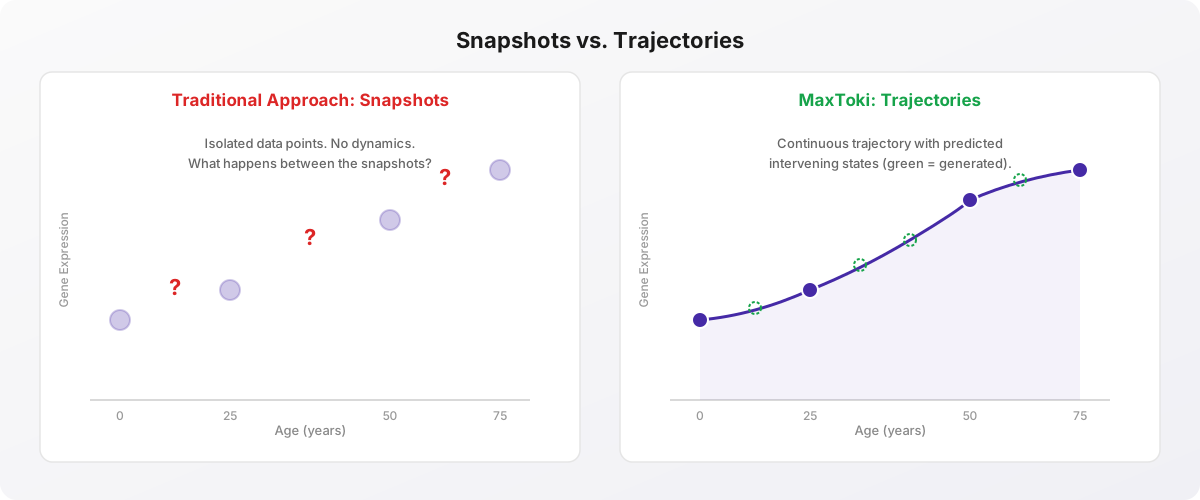
Aging is the single biggest risk factor for nearly every major disease: cancer, heart failure, neurodegeneration, diabetes. Yet for decades, our understanding of how cells actually age has been built from snapshots. Take a biopsy, sequence the cells, compare young versus old. That gives you a before-and-after picture, but not the movie in between.
A new model called MaxToki changes that. Developed by researchers at the Gladstone Institutes in collaboration with NVIDIA, MaxToki is a temporal foundation model first pretrained on ~175 million single-cell transcriptomes, then fine-tuned on 22 million age-annotated cells spanning every decade of life from birth to 90+ years. It doesn’t just compare young cells to old cells. It learns the trajectories of how gene activity shifts over time in each cell type and uses that to predict the future state of any cell, identify genes that accelerate aging, and detect disease-driven aging acceleration.
The preprint landed on bioRxiv on April 1, 2026. The model and code are fully open source.
This post breaks down how MaxToki works, what it found, and why temporal modeling might be the missing piece in aging research.
The Problem With Snapshots
Single-cell RNA sequencing (scRNA-seq) has been one of the most important breakthroughs in modern biology. It lets you measure the gene expression profile of individual cells, giving you a high-resolution map of what each cell is doing at a specific moment.
The problem is that moment is frozen in time.
If you want to study aging, you collect cells from people of different ages and compare them. A 25-year-old’s heart cells versus a 75-year-old’s. You find genes that are differentially expressed and call those “aging-related.” But this cross-sectional approach misses the dynamics. It can’t tell you:
- When does a gene start changing? At 40? At 60? Gradually or suddenly?
- Which changes come first? Does mitochondrial dysfunction drive inflammation, or the other way around?
- What’s the trajectory? Some cell types might age linearly. Others might stay stable for decades then decline sharply.
These are temporal questions, and you need a temporal model to answer them.
What MaxToki Actually Is
MaxToki is a transformer-based foundation model for single-cell transcriptomics with a key twist: it was trained to model cell state trajectories across time, not just individual cell states.
The name comes from a Japanese bullet train, and “toki” is a homonym for “time” in Japanese. Fitting, given what it does.
Architecture
MaxToki comes in two sizes:
| Variant | Parameters | Training Tokens |
|---|---|---|
| MaxToki-217M | 217 million | ~1 trillion |
| MaxToki-1B | 1 billion | ~1 trillion |
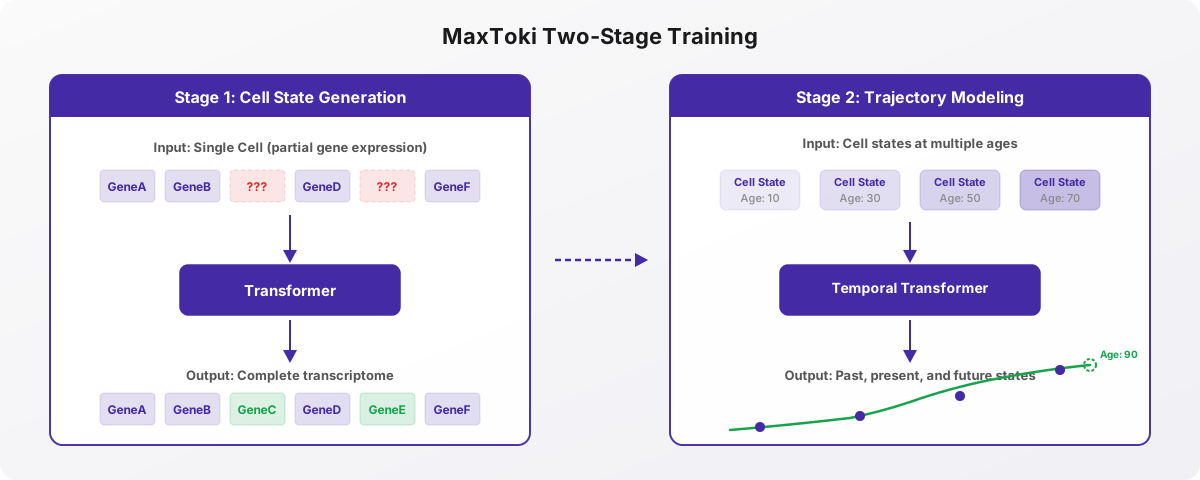
The training process is two-stage:
-
Stage 1 (cell state generation): The model first learns to generate realistic single-cell transcriptomes. Given partial gene expression data, it predicts the rest. This is analogous to masked language modeling in NLP, but instead of predicting missing words in a sentence, it predicts missing gene expression values in a cell.
-
Stage 2 (trajectory modeling): The input size is expanded so the model sees multiple cell states from the same cell type at different ages along a trajectory. It learns how gene network states at one time point direct transitions to future states. This is where the temporal dimension comes in.
After training, MaxToki can generate past, intervening, and future cell states along any trajectory, even ones it has never seen before.
Training Data
MaxToki uses two separate datasets for its two training stages:
Stage 1: Genecorpus-175M. A general-purpose corpus of ~175 million single-cell transcriptomes spanning health and disease. This teaches the model the basic grammar of gene expression.
Stage 2: Genecorpus-Aging-22M. A curated aging-specific dataset of ~22 million single-cell transcriptomes from healthy humans only:
- ~600 human cell types represented
- ~3,800 donors spanning every decade from birth to 90+
- No disease samples, just normal aging
The total training volume across both stages was nearly 1 trillion gene tokens (~290 billion in Stage 1, ~650 billion in Stage 2).
How It Predicts Aging
The core capability is trajectory generation. Given a cell type and an initial state, MaxToki can predict what that cell will look like at any future age. But it goes further than simple extrapolation.
In-Context Learning
One of the most interesting properties of MaxToki is in-context learning for trajectories. The model can generalize to cell types and trajectories it was never explicitly trained on by learning from context provided at inference time.
This is similar to how large language models can perform new tasks from a few examples in the prompt without fine-tuning. MaxToki does the same with cell states: show it a few age-stamped snapshots from an unfamiliar cell type, and it can predict the trajectory.
Prediction Accuracy
The model achieved a median prediction error of 87 months (about 7.25 years) when predicting the age of held-out cell states. For comparison, a linear baseline (SGDRegressor) had a median error of 178 months (about 14.8 years). MaxToki cuts the prediction error roughly in half.
That might not sound razor-sharp, but consider the task: predicting a person’s biological age from the gene expression of their cells, across any of 600 cell types, over a 90+ year span. Getting within 7 years on average is remarkable.
In Silico Perturbation
Perhaps the most powerful feature: MaxToki can run virtual experiments. You can computationally perturb a gene (simulate overexpressing or silencing it) and then predict how the aging trajectory changes. Which genes, when activated, accelerate aging? Which ones slow it down?
This is enormously valuable because running these experiments in a wet lab would take years per gene candidate. MaxToki can screen thousands of candidates in hours.
What It Found
Pro-Aging Genes in Heart Cells
MaxToki nominated a set of candidate pro-aging driver genes in cardiac cell types, genes that the model predicted would accelerate aging when activated.
The researchers picked five of these candidates and tested them experimentally. They activated each gene in human iPSC-derived cardiomyocytes (heart cells grown from stem cells in a dish) and observed the results:
- Inflammation markers went up
- Mitochondrial dysfunction appeared
- Calcium cycling slowed down (calcium signaling is critical for heart contraction)
- Beating became irregular
These are exactly the hallmarks of cardiac aging in humans. The model predicted them from sequence data alone, and the wet lab confirmed them.
They then went one step further. They tested the same genes in living mice and found measurable cardiac dysfunction within a month. The AI’s predictions held up in vivo.
Christina Theodoris, the lead researcher, put it this way: “Seeing them cause functional decline in heart cells, with exactly the kinds of changes we associate with cardiac aging in humans, confirms the model is capturing something real.”
Disease-Driven Aging Acceleration
MaxToki wasn’t trained on disease samples. But when the researchers fed it cells from patients with various diseases, it could detect how much faster those cells had aged compared to healthy controls:
| Condition | Detected Aging Acceleration |
|---|---|
| Pulmonary fibrosis | ~15 years |
| Heavy smokers (lung cells) | ~5 years |
| Alzheimer’s disease (microglia) | ~3 years |
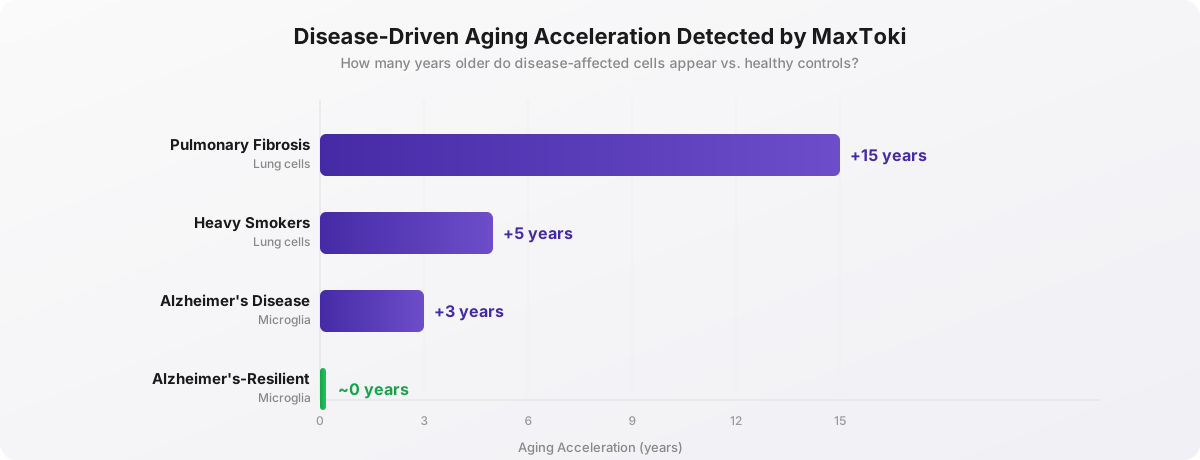
The Alzheimer’s finding is particularly interesting. MaxToki detected ~3 years of accelerated aging in microglia (the brain’s immune cells) from Alzheimer’s patients. But in a subset of patients classified as “Alzheimer’s-resilient”, those who had Alzheimer’s pathology but preserved cognitive function, this acceleration was absent.
This suggests the model is picking up on something mechanistically meaningful about why some people are resilient to neurodegeneration, not just detecting disease presence, but distinguishing between disease and damage.
The NVIDIA Collaboration
Training a model on a trillion tokens of single-cell data is computationally brutal. This is where the NVIDIA partnership was essential.
Gladstone worked with NVIDIA’s BioNeMo stack (built on NeMo, Megatron-LM, and Transformer Engine) along with CUDA-X libraries to optimize the pipeline. The collaboration improved training throughput by roughly 5x, and accelerated inference (generating cell states and identifying anti-aging targets) by over 400x through optimizations like FlashAttention-2 and KV caching via Megatron-Core.
For an academic lab, this kind of infrastructure partnership is the difference between a model that takes a year to train and one that’s feasible within a research timeline. It’s a good example of how industry compute resources, when paired with domain expertise in academic labs, can produce results that neither could achieve alone.
Why Temporal Modeling Matters
MaxToki represents a conceptual shift in how we use AI for biology. Most foundation models for single-cell data, like Geneformer (also from Theodoris’s lab), scGPT, and scBERT, treat each cell as an independent data point. They learn rich representations of cell states but don’t model how those states change over time.
This is like training a language model on individual sentences shuffled randomly, versus training it on coherent paragraphs where each sentence follows from the previous one. The temporal context changes what the model can learn.
For aging specifically, temporal modeling unlocks questions that static models can’t answer:
- Trajectory prediction: What will this cell type look like in 20 years?
- Causal direction: Which molecular changes precede functional decline?
- Intervention timing: When is the optimal window to intervene before a trajectory becomes irreversible?
- Acceleration detection: Is this patient aging faster than expected, and in which cell types?
These are the questions that matter for translating aging research into medicine.
The Bigger Picture
MaxToki sits at the intersection of two powerful trends: foundation models for biology and the science of aging.
On the foundation model side, we’ve seen a surge of large-scale models for biological data. ESM-2 and ESM-3 for proteins. AlphaFold for structure prediction. Evo 2 for DNA. Geneformer for single-cell transcriptomics. Each of these treats biological sequences as a language and applies the transformer architecture to learn patterns that decades of manual analysis couldn’t capture.
MaxToki extends this paradigm by adding the time dimension. Biology isn’t static. Cells change. Organisms age. Diseases progress. Modeling these dynamics, not just the snapshots, is the next frontier.
On the aging side, there’s a growing recognition that aging is not a single process but a collection of cell-type-specific trajectories. Your heart cells age differently from your neurons, which age differently from your immune cells. Understanding these differences, and the genes that drive them, is key to developing interventions that target the right cells at the right time.
The fact that MaxToki is open source (Apache 2.0 license, available on HuggingFace) means any researcher can apply it to their own aging or disease datasets. The training data curation, Genecorpus-Aging-22M, is itself a contribution: a standardized, large-scale dataset of healthy human aging across hundreds of cell types.
What Comes Next
A few directions seem likely:
Disease-specific fine-tuning. MaxToki was pretrained on healthy cells only. Fine-tuning on disease cohorts could enable it to predict disease onset, model disease progression trajectories, and identify therapeutic targets specific to disease-accelerated aging.
Multi-omic extension. The current model works with transcriptomics (gene expression). Adding epigenomics (DNA methylation, chromatin accessibility), proteomics, and metabolomics would give a richer picture of the aging process and potentially improve trajectory prediction.
Clinical aging clocks. Epigenetic clocks like Horvath’s clock estimate biological age from DNA methylation. MaxToki could enable a new generation of transcriptomic aging clocks that are cell-type-specific and trajectory-aware, potentially more informative than bulk tissue clocks.
Drug screening. The in silico perturbation capability could be scaled to screen entire drug libraries for anti-aging effects across multiple cell types simultaneously. Instead of asking “does this drug affect aging?” you could ask “which cell types does this drug rejuvenate, and by how much?”
The Takeaway
MaxToki is not a cure for aging. It’s a tool for understanding aging at a resolution we’ve never had before: the trajectory of every major cell type in the human body, from birth to old age, with the ability to predict what happens when you push or pull specific genes.
The model works. The experimental validation is there. The open-source release means the field can build on it. We’re at the point where AI isn’t just cataloging the molecular signatures of aging. It’s predicting them, perturbing them, and pointing researchers toward genes and pathways that actually matter.
The shift from snapshots to trajectories is a small conceptual move with enormous practical consequences. Time, it turns out, was the missing variable.